The couples budget app
Talk money.
Stay aligned.
A couples budget app for the partner who handles the money, and the one who'd rather not. Shared envelopes, fun money that stays yours, and one short weekly check-in that keeps you both on the same page about money.


For two
The talking kind.
Why we built this
Money isn't what couples fight about most. But money fights hit harder, and more often get pushed to 'later' (a diary study of 100 married couples, Family Relations, 2009). We think we know why most couples don't talk about it, and what to do instead.
Ours · Mine · Partner's
Shared money together. Fun money that stays yours.
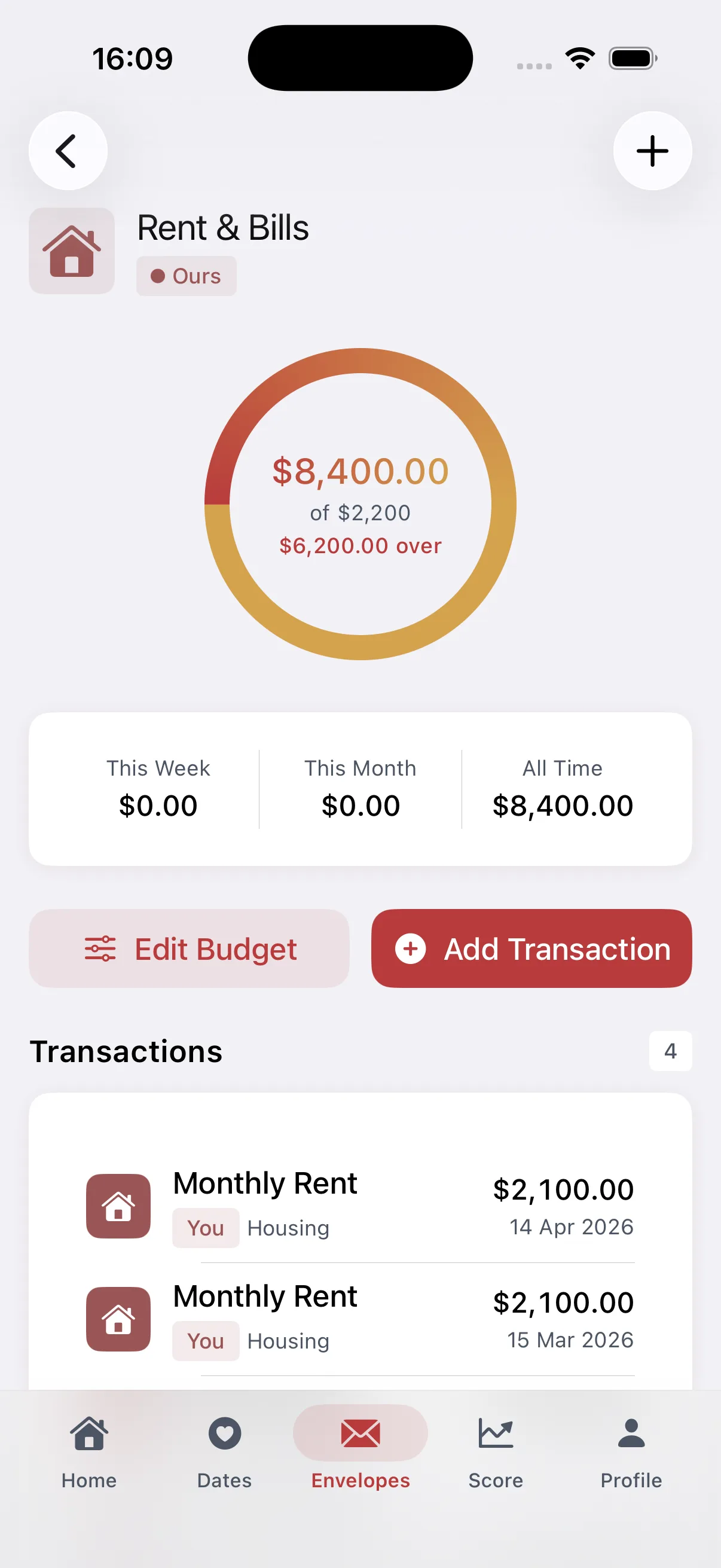
Ours holds the shared life: rent, groceries, the trip you're saving for. Each of you also gets a personal envelope. Your partner sees its total, never the purchases inside it, so nobody has to explain a coffee.
No bank login
You add spending yourself. Nothing to link, nothing to reconnect.
Tap an amount on the keypad, say it out loud, or share a receipt or payment confirmation to DuetWallet from another app. Because nothing is linked, it works with any bank, and nothing breaks when a bank connection fails.
Home-screen widget
For the partner who'd rather not open the app.
Put an envelope, say groceries, on the home screen or lock screen and see how much of its budget is spent at a glance.
The weekly check-in
One short check-in a week, agenda included.
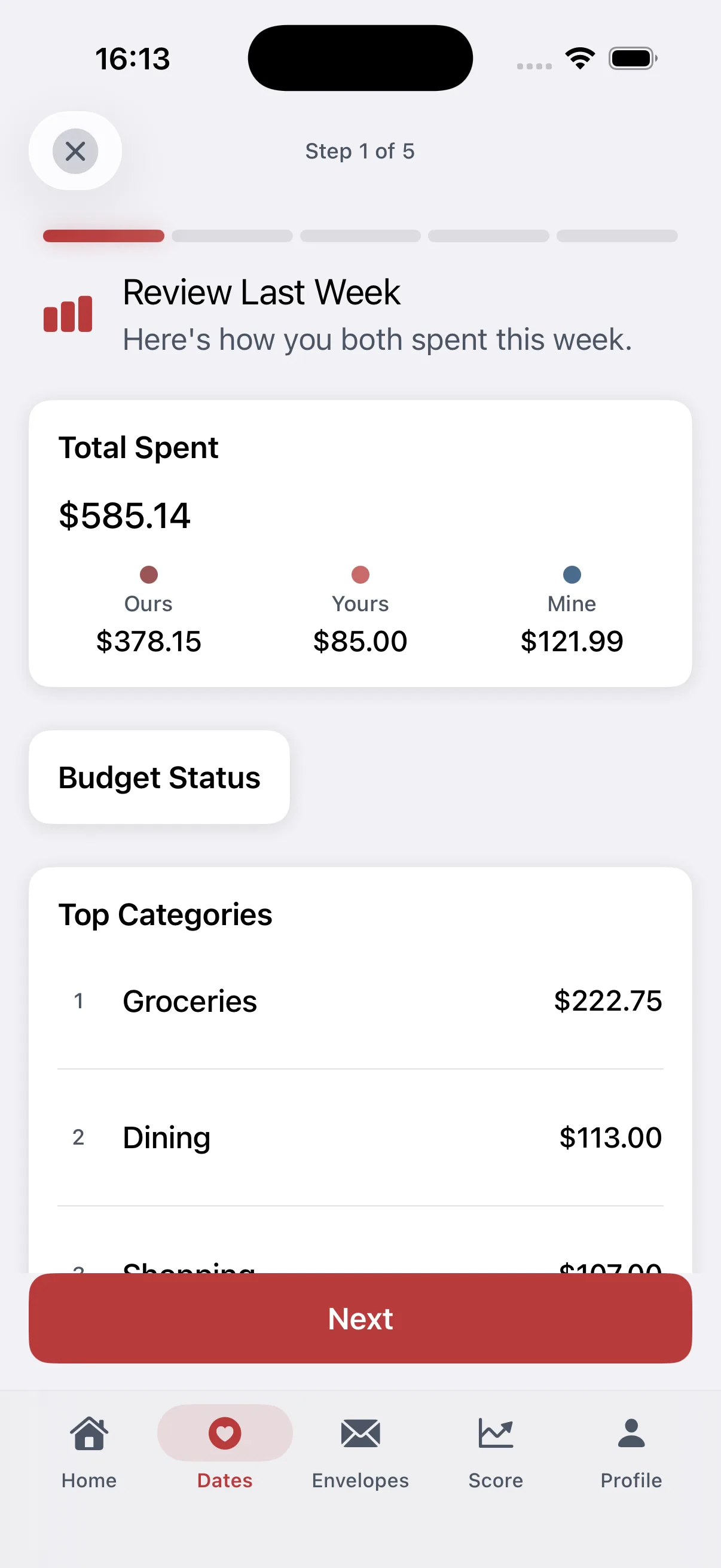
The Money Date is DuetWallet's weekly check-in. The app walks you both through the same steps every time: what you spent, what you saved, what's coming up, and what felt off. Nobody has to prepare a spreadsheet or run the meeting.
What it is
DuetWallet is a couples budget app for two people who share some money and keep some of it their own. It's built for the common setup where one partner runs the money and the other would rather not: shared envelopes for what you pay for together, a personal envelope each that your partner sees only as a total, and a weekly Money Date that keeps you on the same numbers without turning into an audit. Where apps like Honeydue connect to your bank and show both partners every transaction, DuetWallet keeps personal spending private and asks for no bank login at all.
What we believe
The ideas DuetWallet is built on.
Money fights aren't about money.
They're about safety, freedom, and fairness, and what we're scared will happen if our partner doesn't see it our way. DuetWallet gives you a calm, weekly place to talk before the small things turn into the big fights.
A short check-in beats a long budget meeting.
A budget one person runs alone is easy to abandon. A fifteen-minute weekly Money Date is small enough to actually keep, and it puts both of you on the same numbers without anyone playing the money police.
Your money stays yours.
No ads, no data selling, no third-party tracking. Your partner sees your personal envelope's total, not the purchases inside it. The point is trust between the two of you, never surveillance.
Common questions
Frequently asked questions
What is a Money Date?
A Money Date is DuetWallet's short weekly check-in: a fifteen-minute guided conversation about what you spent, what you saved, what's coming up, and what felt off. The app walks you through five steps, so nobody has to prepare anything or run the meeting. Just open the app together and tap through.
Do we both need to use the app?
Yes, but the second partner doesn't have to do the budget. After you sign up, you send your partner an invite. They create their own account, with its own subscription, and the two of you are paired into a shared household. Each of you also gets a personal envelope: your partner sees its total, not the individual purchases. The partner who'd rather not can check an envelope from the home-screen widget and just join the weekly check-in.
Does DuetWallet connect to my bank?
No, and that's deliberate. You add spending yourself with the keypad, your voice, or the iPhone share sheet, so there's no bank login to share and nothing to reconnect when a bank connection fails. It works with any bank. The trade-off is that nothing is imported automatically: if that matters most to you, an app with bank sync will suit you better.
Does it work on Android?
Not yet. DuetWallet is iPhone only for now, and both partners need an iPhone to use it together.
How is this different from Honeydue or other couples-finance apps?
Honeydue connects to your banks and shows both partners' transactions in one place. DuetWallet asks for no bank login: you log spending yourself, shared spending goes in Ours, and each of you has a personal envelope that the other sees only as a total (Mine for yours, Partner's for theirs). A short weekly check-in, the Money Date, ties it together, and an Alignment Score tracks how in sync you are over time. See our /vs/honeydue page for the full breakdown.
What does it cost?
You'll start with a 14-day free trial with full access, then a subscription you can cancel anytime. Billing is per person: you and your partner each have your own subscription. We'll share exact pricing closer to launch.
What about our privacy?
We don't sell, share, or rent your data. No ad networks, no third-party tracking. Anonymous product analytics (Aptabase, EU-hosted) is all. Your transactions live in an encrypted local SQLite database on each phone, synced through our secure backend over HTTPS.
When does DuetWallet launch?
Soon, on iPhone. Join the waitlist above and we'll email you the day it goes live on the App Store. Until then you'll get a short welcome series: four emails over about three weeks about Money Dates and how DuetWallet works. Every email has a one-click unsubscribe link.
Free to read
Learn to talk money, before you download.
How to talk about money with your partner
The seven conversation patterns that turn money fights into money dates.
Couples budgeting methods, compared
Five budgeting systems side by side: what each one asks of you, who it suits, where it breaks, and how couples combine them.
Shared financial goals for couples
How to surface what each of you actually wants, prioritize across competing goals, fund them without resentment, and keep going when one of you falls behind.
How to budget as a couple
A budget two people can actually keep: how to pick a system, split fairly, and turn it into a fifteen-minute weekly habit instead of a fight.
How to combine finances when you move in together
Three models, one honest conversation, and a 90-day plan for merging money without losing yourselves.
Should couples have joint bank accounts?
Joint, separate, or hybrid: an honest look at what the research actually says, and why the structure matters less than the conversation around it.
Launching soon